

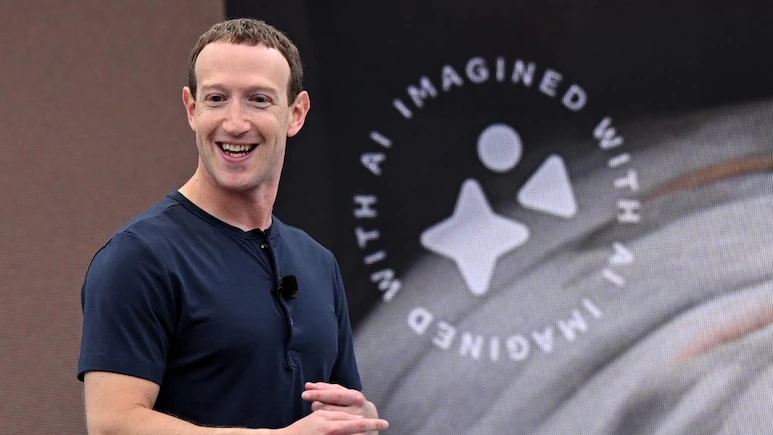
Artificial intelligence has rapidly reshaped nearly every major industry, but few fields stand to experience a deeper transformation than software development. According to a recent report from NDTV World, Meta CEO Mark Zuckerberg believes that AI is on the verge of becoming the primary engine of code generation for large-scale projects. Speaking on the Dwarkesh Patel podcast, Zuckerberg outlined a future in which AI not only assists developers but is responsible for writing the majority of code with minimal human intervention.
Zuckerberg stated that AI models at Meta have already reached the skill level of an average team member. He emphasized that the capabilities of these systems are improving at an unprecedented pace and predicted that within 12 to 18 months, most coding tasks inside Meta will be completed by AI. This is a remarkable shift from the current landscape, where AI mostly provides coding suggestions or auto-completes small sections of code.
He explained that the leap forward will come from AI agents that understand goals and build end to end solutions. These systems will not merely offer syntax suggestions. Instead, they will generate full features, run tests, detect issues, and deliver high quality output that matches or surpasses the work of experienced engineers. Zuckerberg noted that existing auto-complete tools perform well, but the next generation of Meta’s AI agents will operate at a higher strategic level.
In this news report for Karina Web, we analyze what this shift means for software engineering teams, the broader technology ecosystem, and the future of programming as a profession.
Meta is Building AI Coding Agents for Internal Use Only
One of the most striking aspects of Zuckerberg’s remarks is that Meta is not planning to commercialize these coding agents. In his words, Meta is not an enterprise software company and has no intention of turning these tools into general developer products. Instead, the company is building specialized agents tailored exclusively to the needs of Meta’s infrastructure and research pipelines.
According to him, these agents are fully integrated with Meta’s internal toolchain and development systems. This means they understand Meta’s engineering standards, internal APIs, deployment processes, and testing frameworks. Such deep integration allows them to deliver work that fits seamlessly into ongoing projects.
Zuckerberg clarified that the primary purpose of these tools is to support Llama research. Llama has become one of the most influential open source AI models in the world, rivaling closed systems such as GPT and Google’s Gemini. Meta’s investment in coding agents reflects its goal to accelerate research, experimentation, and iteration around the Llama project.
The Industry Contex t: AI Already Writes a Large Share of Code
The shift toward AI generated code is not limited to Meta. As the NDTV World report noted, Microsoft CEO Satya Nadella recently revealed that 20 to 30 percent of Microsoft’s internal code is already being written by AI systems. This percentage is expected to grow significantly over the next few years.
With major industry players adopting AI in their development pipelines, the broader software ecosystem is undergoing a foundational transformation. What once sounded like a futuristic prediction has quickly become a practical reality. Tools that were once considered experimental are now part of everyday workflows, and companies that fail to adopt AI assisted development risk falling behind.
What This Means for the Future of Software Engineering
As AI systems become more capable of writing code, many programmers are understandably concerned about the security of their jobs. If AI can produce high quality code faster and cheaper than human developers, what will happen to traditional engineering roles?
In this news report for Karina Web, it is important to highlight that industry leaders, including Zuckerberg, are not predicting the disappearance of software engineering. Instead, they foresee a redefinition of the role. Many tasks that were historically performed manually will be automated, but human oversight and design will remain essential.
AI excels at repetitive, structured, rule based tasks. It is highly effective at generating code, identifying errors, and optimizing performance. However, AI still struggles with conceptual design, creative problem solving, strategic planning, and systems architecture. These areas require human insight and understanding of long term product goals.
As a result, the role of the software engineer is likely to shift from writing code line by line to designing systems, supervising AI generated results, specifying objectives, validating outputs, and focusing on high level engineering decisions. Rather than replacing programmers, AI may elevate the profession by removing tedious tasks and allowing developers to concentrate on more meaningful work.
The Llama Ecosystem at the Center of Meta’s Vision
Llama has become a central pillar of Meta’s AI strategy. Unlike many competing models, Llama is open source, which has allowed thousands of researchers and developers worldwide to contribute to its growth. By integrating coding agents directly into Llama’s development cycle, Meta aims to accelerate innovation and remain at the forefront of global AI research.
The advantages of this approach include faster iteration speeds, more reliable testing, and the ability to experiment with new architectures without requiring massive manual labor. When AI agents can write experiments, run evaluations, and analyze results automatically, research can progress at a pace that was previously impossible.
For Meta, the combination of open source development and internal AI driven engineering could result in an unprecedented acceleration of AI capabilities and widespread adoption of Llama across academic, commercial, and industrial applications.
Can AI Truly Write Better Code Than Humans?
A central claim in Zuckerberg’s interview is that AI will soon write code that is higher quality than what most human programmers can produce. While this might seem bold, recent evidence supports the idea that AI generated code is rapidly catching up to and in some cases surpassing human produced code.
AI models have begun outperforming humans on many coding benchmarks. They can refactor legacy systems effectively. They can detect vulnerabilities with high accuracy. They can generate optimized code in languages where efficiency is critical. Moreover, AI can analyze enormous datasets of real world codebases, something no human could do.
However, AI systems can also produce hallucinations, logic errors, or insecure code if not properly supervised. Therefore, even if AI becomes an expert level coder, the role of the human engineer in reviewing, validating, and guiding the system will remain essential.
A Future Where AI Becomes a Development Partner
In this report for Karina Web, the most important takeaway is that the future will likely see AI acting as a partner rather than a replacement. Just as calculators did not eliminate mathematics and design tools did not eliminate architects, AI generated code will not eliminate programming. Instead, it will shift the focus of engineering from manual creation to strategic oversight.
Companies that adapt early to this paradigm will enjoy dramatic increases in productivity. Products will be built faster. Bugs will be resolved quicker. Innovation cycles will shrink from months to days. The companies that embrace this change stand to gain a significant competitive advantage.
Conclusion
Mark Zuckerberg’s prediction, as reported by NDTV World, signals a turning point in the evolution of software development. If his timeline is accurate, the next 12 to 18 months will usher in an era in which AI handles the bulk of coding work at Meta and likely across the industry. This will impact how engineers work, how software is built, and how quickly AI research progresses.
As covered in this detailed report for Karina Web, the key insight is that the future of programming is not the disappearance of coders but the transformation of their role. The developers of tomorrow will be architects, reviewers, and supervisors of intelligent systems that produce code at unprecedented speed and scale.
If you want, I can also provide a shorter version, an SEO optimized version, or a social media friendly summary.
Source: ndtv.com